
Imagine trying to sell a state-of-the-art snowmobile to a surfer living in Hawaii. It doesn’t matter how incredible the product is, how sleek the design looks, or how competitive the pricing is—the sale simply won’t happen. The message is completely mismatched with the audience’s reality.
This is the exact problem that segmentation solves. Instead of shouting into the void, modern businesses use data-driven strategies to deliver the right message to the right person at the right time. If you want to see exactly how industry leaders pull this off, analyzing concrete Examples for market segmentation in marketing is the best place to start.
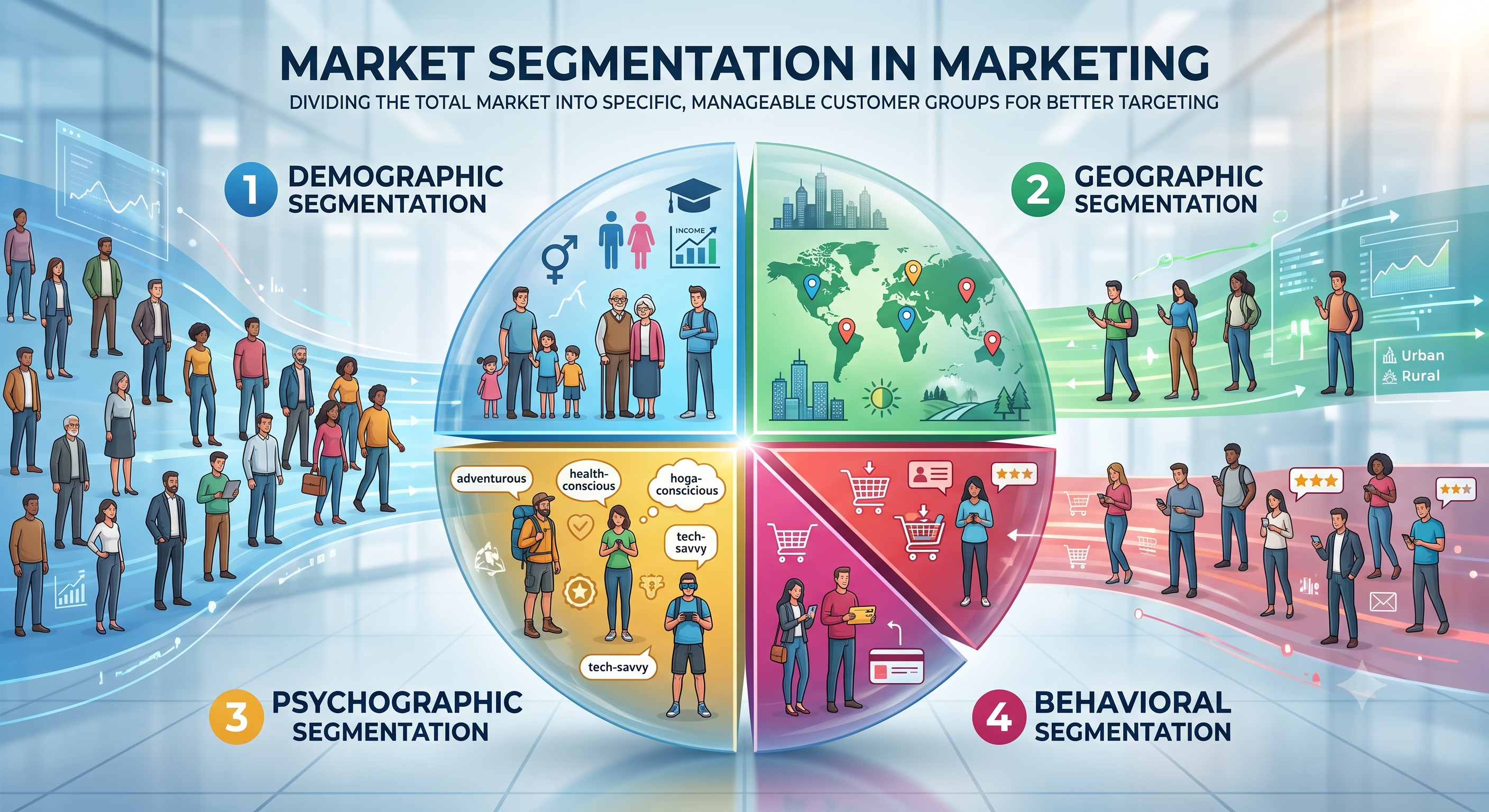
Below, we will explore detailed, evidence-based case studies for the five core types of segmentation, demonstrating how precise targeting translates into measurable business growth.

1. Demographic Segmentation: The Fitness Industry Divide
Demographic segmentation relies on quantifiable data like age, income, and occupation. To see the evidence of its power, look no further than the fitness industry, where two brands can sell the exact same core service (access to workout equipment) to entirely different demographics.
Consider the strategic difference between Planet Fitness and Equinox.
Planet Fitness targets a lower-to-middle-income demographic, often skewing toward younger individuals or budget-conscious families. Their marketing emphasizes a “Judgement Free Zone” and a hyper-affordable $10/month price point. The evidence of this working is in their massive volume of memberships.
Equinox, on the other hand, targets a high-income demographic. Their memberships can exceed $300 a month. Their marketing completely ignores price; instead, it focuses on exclusivity, high-end eucalyptus towels, spa services, and elite personal training.
By defining their demographic clearly, neither brand wastes advertising spend trying to convert the other’s ideal customer.
2. Geographic Segmentation: Fast Food Localization
Geographic segmentation goes beyond just shipping logistics; it dictates product development based on local culture, climate, and regional tastes.
Global food and beverage giants are masters of this. While you might assume a brand like Coca-Cola tastes the same everywhere, the company actually adjusts the sweetness and carbonation levels of its beverages depending on the country, based on local palate preferences.
Similarly, fast-food chains provide textbook Examples for market segmentation in marketing when applied geographically. A standard Domino’s Pizza menu in the United States heavily features pepperoni and sausage. However, in India—a country with a massive vegetarian population and specific religious dietary practices—the menu is drastically different. Domino’s India offers localized items like the “Peppy Paneer” and ensures strict segregation of vegetarian and non-vegetarian kitchens to respect local cultural norms. This geographic precision is the primary reason for their dominant market share in the region.
3. Psychographic Segmentation: The Automotive Identity
Psychographic segmentation looks at the psychological drivers of a purchase—values, lifestyle, and personality. People don’t just buy cars to get from point A to point B; they buy them to signal who they are to the world.
Look at the marketing strategy of Subaru. Their campaigns rarely focus on horsepower or zero-to-sixty times. Instead, Subaru uses deep psychographic targeting, focusing on consumers who value outdoor adventure, family safety, and pet ownership. Their commercials often feature golden retrievers and camping trips. They are targeting a mindset.
Contrast this with Porsche. Porsche targets a psychographic segment driven by status, performance, and thrill-seeking. Their advertising focuses on precision engineering, speed on the track, and luxury aesthetics. Both companies sell four wheels and an engine, but they speak to fundamentally different human desires.
4. Behavioral Segmentation: The Streaming Algorithm
Behavioral segmentation is perhaps the most evidence-based approach because it relies entirely on what a user actually does, rather than who they claim to be.
Spotify and Netflix have built empires on behavioral segmentation. Spotify tracks every skip, replay, and playlist addition. They use this behavioral data to segment users into incredibly niche micro-genres, creating the heavily personalized “Discover Weekly” playlists.
Netflix takes this a step further. They don’t just segment what movies they recommend; they dynamically change the thumbnail artwork of a movie based on your past behavior. If the data shows you watch a lot of romantic comedies, the thumbnail for a movie like Good Will Hunting will feature Matt Damon and Minnie Driver looking romantic. If you watch a lot of comedies, the thumbnail will feature Robin Williams. This is behavioral segmentation happening in real-time, drastically increasing click-through rates.
5. Firmographic Segmentation: B2B Software Tiering
For Business-to-Business (B2B) companies, targeting relies on firmographics—the characteristics of a company, such as employee headcount, industry, and annual revenue.
Software-as-a-Service (SaaS) companies like HubSpot provide clear Examples for market segmentation in marketing within the B2B space. HubSpot does not market to a “business.” They segment their audience into distinct tiers:
Startups/Small Businesses: Targeted with their “Starter” tier. The messaging focuses on saving time, easy setup, and low introductory costs.
Enterprise Organizations: Targeted with their “Enterprise” tier. The messaging shifts entirely to focus on advanced custom reporting, multi-team governance, and complex API integrations.
If HubSpot tried to sell their complex, expensive Enterprise features to a three-person startup, the deal would immediately fall through. Firmographic segmentation ensures sales teams are only pitching the right solution to a company that actually has the budget and infrastructure to support it.
The Bottom Line
Reviewing these Examples for market segmentation in marketing reveals one undeniable truth: specificity wins. The deeper you understand the nuances of your audience—whether it is their income bracket, their location, their internal values, their digital behavior, or their company size—the more effectively you can serve them.
Marketing is no longer about reaching the most people; it is about reaching the right people with a message that feels like it was written exclusively for them.